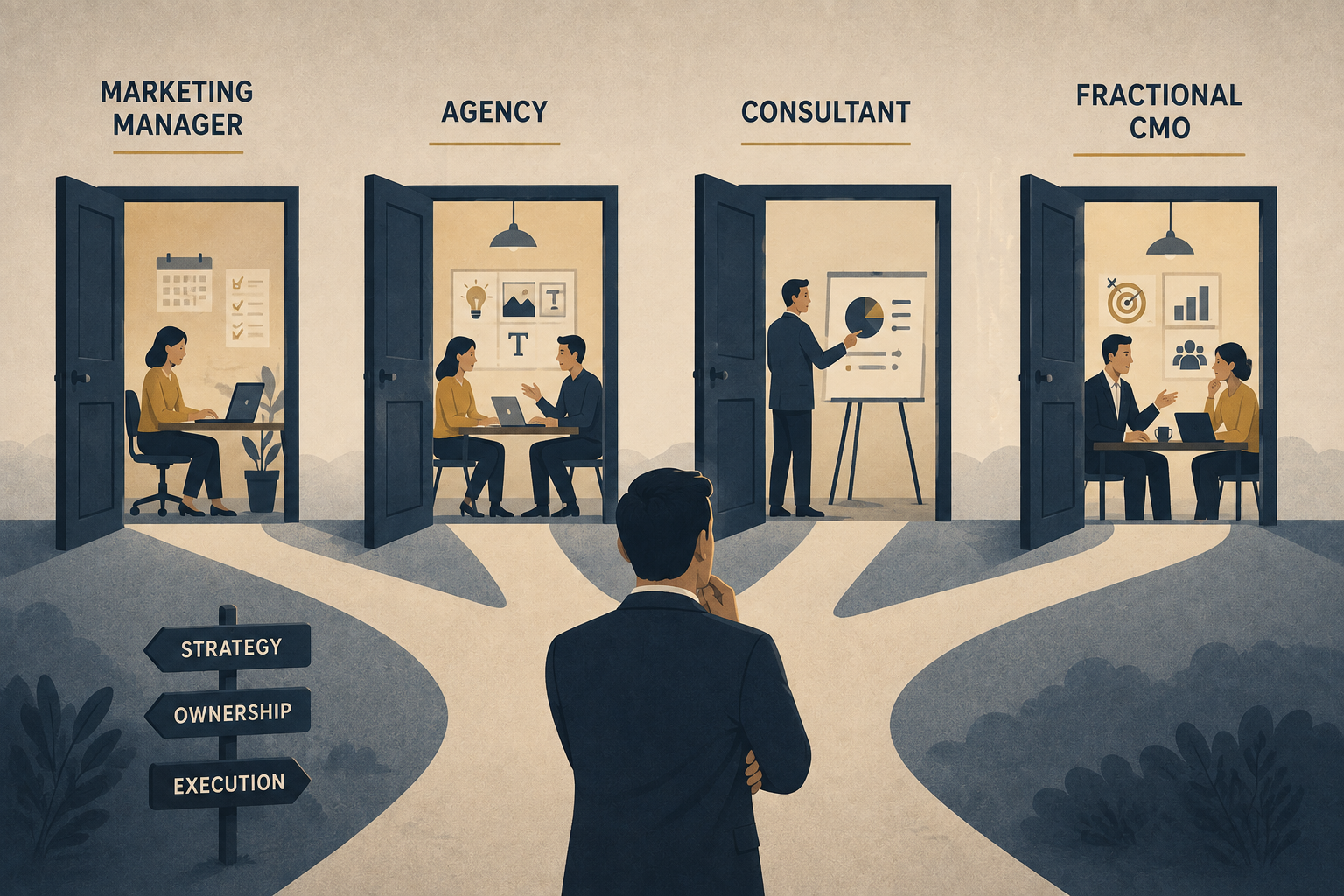
A founder once told me, quite simply, “We need someone for marketing.”
That sounded straightforward enough. As the conversation continued, however, the requirement became much larger. The person would need to improve the company’s positioning, plan marketing activity, coordinate agencies, guide the website, help sales with collateral, approve content, review performance and make sure everything actually moved.
By the end of the conversation, it was clear that the company was not looking for one generic “marketing person.” It was trying to solve several different marketing problems through a single role.
This happens often in growing businesses. The title gets discussed before the responsibility is understood. A company starts comparing a marketing manager, an agency, a consultant and a Fractional CMO without first asking what it actually needs someone to own.
That is where the confusion begins.
Marketing problems often disguise themselves as hiring problems
Most businesses do not wake up one morning with a neatly defined marketing requirement.
They feel symptoms first. The website looks weak. Leads are inconsistent. The sales team wants better material. Content is irregular. Agencies need too much supervision. The founder keeps getting pulled into approvals. Competitors suddenly seem more visible.
The natural response is to hire someone.
The difficulty is that these symptoms can come from very different underlying problems.
A company may think it needs a marketing manager when its real problem is unclear positioning. It may appoint an agency even though nobody internally knows what the agency should be communicating. It may bring in a consultant to create a strategy, then discover that nobody is available to own the decisions once the engagement ends.
The opposite happens too. A business may bring in senior strategic marketing leadership when the strategy is already clear and what it really needs is a capable person to keep execution moving every day.
Before choosing the role, it helps to separate four needs that are frequently bundled together.
There is strategic clarity: deciding which market matters, what the company should be known for and how it should compete.
There is senior marketing ownership: deciding priorities, resolving disagreements and connecting marketing with wider business goals.
There is day-to-day execution: ensuring that campaigns, content, events, agencies, systems and deliverables actually move.
And there is specialist capability: bringing in skills such as performance marketing, design, PR, SEO, website development or media buying.
Different marketing models solve different combinations of these problems.
When a marketing manager is exactly what the business needs
A good marketing manager can become one of the most valuable people in a growing company.
They sit close enough to the business to understand what is happening every day. They can coordinate campaigns, work with agencies, manage calendars, support events, follow up on deliverables, maintain marketing systems and make sure plans do not remain trapped in presentations.
This model works especially well when the larger direction is reasonably clear.
Leadership already understands who the priority customers are. The company has a working positioning. Marketing objectives are tied to business priorities. Someone senior can resolve strategic questions when they arise.
In that environment, the marketing manager converts direction into consistent activity.
The problem begins when the job quietly becomes a CMO role
Many companies hire a mid-level marketing manager and then expect that person to define the entire business position.
They are asked to decide the go-to-market strategy, challenge the founder, align sales and marketing, determine budgets, supervise multiple agencies, define the annual plan and somehow remain responsible for daily execution.
The job description may still say “Marketing Manager.” The expectations belong at a different level.
When the hire struggles, the company may conclude that the individual was not strategic enough. Sometimes that assessment is fair. In other cases, the business has designed a role that asks one person to operate simultaneously as strategist, senior leader, coordinator and executor.
That is not a talent problem. It is a role-design problem.
A marketing manager should have room to think and contribute strategically. Expecting every manager to independently define the company’s market position and carry executive-level responsibility is a different proposition.
When an agency is the right answer
Agencies make enormous sense when the business needs specialist capability or additional execution capacity.
A company may have a clear marketing strategy but lack strong performance marketing expertise. It may need a new website, a serious PR programme, search marketing, high-volume creative production or media planning. Building each of these capabilities permanently inside the organisation may be expensive and unnecessary.
A good agency brings specialists, outside perspective and experience across several clients and markets.
Some agencies can also make substantial strategic contributions. Strong agency leaders will challenge a weak brief, conduct research and help improve the company’s thinking.
Even then, the business needs someone who can make the final strategic decisions.
An agency needs more than information
I saw this clearly while working with a long-established coaching institution.
The institution had appointed an agency with a capable content team and good designers. The agency regularly produced material around courses, admissions, student success stories and examination-related content.
The work looked professional. Yet if the logo was removed, much of it could have belonged to almost any coaching centre in the city.
The agency knew what services the institution offered. What it had never received was a clear answer to why a student should choose this institution after the market had become far more crowded and the chief mentor, whose reputation had driven much of its early success, had stepped back from active teaching.
That distinction matters.
An agency can work with a position, sharpen it, challenge it and express it creatively. It cannot reliably compensate for a business that has never decided what it wants to stand for.
When the strategic brief is weak, even good agencies can produce polished work that remains generic.
When a consultant is the better choice
There are many situations where a company does not need ongoing marketing leadership.
It may have one clearly defined problem.
Perhaps the business needs a positioning exercise. It may want an external review of its go-to-market strategy, an audit of its agencies, advice on entering a new market or help redesigning its brand architecture.
A consultant can be ideal for this kind of work.
The engagement can have a defined beginning and end. The consultant studies the situation, brings an outside perspective, develops recommendations and may help establish the first version of the solution.
If the company already has capable people who can take over from there, the model works very well.
The distinction appears after the recommendation
The real question is what happens when the consultant leaves.
A strategy that looked clear during the final presentation may become less obvious once execution begins. An agency interprets one part differently. Sales pushes for another priority. A new competitor enters the market. Leadership changes direction. Budget decisions need to be made.
If the company can handle those questions internally, the consulting engagement has done its job.
If someone still needs to make senior marketing decisions every week or every month, the requirement has moved beyond a project.
The company now needs continuing ownership.
When a Fractional CMO becomes relevant
A Fractional CMO makes sense when a business needs senior marketing leadership on an ongoing basis but does not yet require, or cannot justify, a full-time CMO.
The distinction lies in responsibility.
A Fractional CMO should remain involved after the strategy presentation. The role may include positioning, go-to-market direction, budget priorities, agency leadership, sales-marketing alignment, performance review and the continuing translation of business strategy into marketing decisions.
The work is usually closest to the founder or leadership team because many of the questions are commercial rather than merely promotional.
Which customer segment deserves priority? Which part of the business should lead the story? Should the company invest in demand generation now or strengthen its sales enablement first? Is the agency solving the right problem? Does the company need to reposition before increasing media spend?
These decisions require judgement over time.
A Fractional CMO should therefore not be viewed as an expensive marketing manager who happens to work fewer days.
The value lies in senior ownership and integration.
When a Fractional CMO is the wrong answer
The model is not appropriate for every business.
If the strategy is already strong and the company mainly needs someone to coordinate daily activity, a good internal marketing manager may be the better investment.
If the business needs only paid media expertise, a specialist agency or performance marketer is likely to be more useful.
If the company has one defined positioning problem and a capable internal team ready to execute afterwards, a consultant may be sufficient.
And if the business has reached a scale where senior marketing leadership needs to be present full-time, building a permanent CMO role may make more sense.
The fractional model becomes useful when the leadership need is real and continuing, while the full-time executive structure is still premature.
A manufacturing business made the distinction very clear
I saw this operating-model question play out in a 15-year-old industrial manufacturing company.
The company had built a strong sales team and grown for years through manufacturing quality, relationships and an early position in a niche market. Marketing had remained relatively rudimentary because the business did not need much more.
Then competition intensified.
Comparable products started entering from other countries at significantly lower prices. Traders became more active. Buyers began asking harder questions about quality and price.
The company had people who could sell. It needed someone to decide how the business should respond.
Hiring another salesperson would not have solved that.
Hiring a designer would not have solved it either. An agency could certainly build the website, create collateral and produce content, but somebody still had to establish what all of those materials should say.
My work began with the founder. We had to understand what genuinely differentiated the company, translate that into a market narrative, align the sales team around it and then guide the website, collateral and founder communication from the same direction.
The company needed marketing resources, but the first missing layer was marketing leadership.
That distinction is easy to miss because both can eventually produce visible output.
The wrong hire can look perfectly sensible at first
Many marketing operating-model mistakes do not look irrational when they are made.
A company hires a young marketing manager because the person is energetic, digitally fluent and affordable. Six months later, leadership is frustrated that the person has not resolved positioning questions that senior management itself has never answered.
Another company appoints a respected agency and assumes the agency will somehow discover the business’s differentiation while working from old brochures and fragmented internal feedback.
A consultant creates an excellent strategy, but nobody inside the company has enough authority or time to protect that strategy once daily pressures return.
A Fractional CMO is brought into a company that already knows what it wants to do but desperately needs somebody to execute forty hours a week. The relationship disappoints because the business hired strategic bandwidth when it needed operational capacity.
In all four cases, the people involved may be competent.
The mismatch lies between the problem and the capability purchased.
That is why “Who should we hire?” is often the second question.
The first is “What do we need this person or partner to own?”
Four questions clarify most of the decision
The answer becomes easier when leadership works through a few practical questions before discussing titles.
Is our marketing direction already clear?
Can the leadership team explain which customers matter most, what the company wants to be known for and why those customers should choose it?
If the answers vary significantly depending on whom you ask, the company probably has a strategic clarity problem.
Someone senior needs to help establish that direction before execution can become consistently effective.
Do we need a defined intervention or continuing judgement?
A company may need help solving a problem once. That points towards consulting.
Another company may face senior marketing decisions continually. The market is changing, agencies need direction, sales needs alignment and priorities need to be revisited. That requires continuing ownership.
The distinction between project work and leadership work matters more than the title used.
Does someone need to be inside the business every day?
Some marketing roles depend heavily on daily presence.
Campaigns need coordination. Events need follow-up. Content needs scheduling. Internal teams need constant communication. Agencies need materials and approvals.
If these responsibilities dominate the requirement, an internal marketing manager or team is likely to be important.
Senior strategy cannot substitute for operational bandwidth.
Are we missing specialist expertise?
Sometimes the answer is much simpler.
The company already has leadership and internal coordination. It needs excellent performance advertising, design, PR, SEO or media expertise.
That is exactly the problem agencies and specialist partners are designed to solve.
There is little value in rebuilding every capability internally simply because the company has reached a certain size.
A simple way to think about the options
| Business situation | Likely best fit |
|---|---|
| Strategy is clear, but daily marketing execution needs ownership | Marketing Manager |
| Internal strategy exists, but specialist execution is missing | Agency |
| A specific strategic marketing problem needs solving | Consultant |
| Senior marketing direction and continuing ownership are missing | Fractional CMO |
| The company requires permanent executive-level marketing leadership | Full-time CMO |
This is only a starting point. Real businesses rarely fit perfectly into one box.
What matters is that leadership understands what each model is being asked to solve.
Sometimes the right answer is a combination
Marketing organisations do not have to choose one model forever.
A Fractional CMO may work with an internal marketing manager and several specialist agencies. The Fractional CMO provides senior direction, the manager keeps day-to-day work moving, and the agencies contribute specialist execution.
A full-time CMO may rely heavily on external agencies for creative, performance marketing or PR.
A consultant may help a company establish its positioning before handing the framework to an internal team.
A founder-led company may initially combine a Fractional CMO with a marketing coordinator, then build a permanent marketing department as the business grows.
The operating model should evolve with the organisation.
The useful question is whether four things have clear ownership somewhere in the system: strategy, senior decision-making, daily execution and specialist capability.
Once those responsibilities are visible, job titles become much easier to evaluate.
Define the missing responsibility before defining the role
When a founder says, “We need someone for marketing,” my instinct is now to understand the missing responsibility before discussing the person.
Which decisions currently return to the founder because nobody else can make them?
Which work is simply not getting done?
Which capabilities are missing from the existing team?
And which marketing problems genuinely require senior judgement?
The answers may lead to a marketing manager, an agency, a consultant, a Fractional CMO or a full-time marketing leader. In some businesses, they will lead to a combination.
None of these models is inherently more sophisticated than the others. They solve different problems.
The expensive mistake is hiring one kind of capability and expecting it to solve a completely different one.